
Foxhunting:
Fox Hunting 101 Youtube video - how to find a hidden radio transmitter in three easy steps by Joe Domaleski, KI4ASK
How to Build a 2 meter Tape Measure Yagi Beam Antenna
Byonics Foxhunt Controllers - you only need one of these if you want to build your own fox. You do not need these for hunting.
SigTrax app - foxhunt mapping app for Android and IOS.
FoxHunt Pro4.3 - foxhunt mapping app for IOS (paid version only)
APRS - Automatic Packet Reporting System
aprs.fi - APRS tracking map
aprs.to - another APRS tracking map
Beginner’s guide to Using APRS for Ham Radio by Ham Radio Prep
How APRS Works and other resources from the APRS Foundation Inc
APRS Demystified: The Versatile Tool for Modern Amateur Radio - “APRS stands for Automatic Packet Reporting System (not "position reporting.") It was developed by Bob Bruninga WB4APR (SK) while he was a senior research engineer at the United States Naval Academy in the 1980s, using an Apple II computer, for the purpose of tracking Navy ships at sea. It has since evolved into much more than a mere location-tracking system … APRS is now is a tactical, real-time information sharing and communications system that provides situational and spatial awareness of your immediate local area.”
Automatic Packet Reporting System - article on Wikipedia
APRSdroid - allows reporting your position to the APRS (Automatic Packet Reporting System) network, displaying of nearby amateur radio stations, and the exchange of APRS messages.
You can use APRSdroid to connect to the APRS network via different means:
APRS-IS via Internet (WiFi or mobile data connection) (you can send beacons via the internet, without a radio)
AFSK (audio connection between your radio and the smartphone) (I could not get this to decode packets from the speaker of a radio)
Bluetooth-serial connection to a TNC (like on the BTech UV-Pro)
Once connected, you can beacon your presence, see which stations (amateurs and repeaters) are around and send/receive APRS messages.
Offline Maps on APRSdroid - It is possible to have offline maps on APRSdroid but you must use an unofficial version by NA7Q. To see how this is done, check out the Youtube video by KM4ACK.
Aircraft Flight Tracking
ADSB Exchange - a flight-tracking service built around an independent ADS-B receiver network and is especially popular with aviation enthusiasts who want a more raw, less-filtered view of what is flying. It emphasizes live tracking, historical data, detailed ADS-B information, and broad visibility across military, commercial, and private aircraft.
Flight Aware - a broader aviation data platform that serves both everyday users and the aviation industry. It combines data from government sources, airlines, commercial providers, and its own receiver network to provide live tracking, flight status, delay prediction, alerts, analytics, and enterprise data products.
Flight Radar 24 - a global real-time flight tracker best known for its easy-to-use live map and popular mobile app. It combines ADS-B, MLAT, satellite, and radar data with airline and airport schedule information, so it is especially good for visually following flights and getting a polished consumer-friendly tracking experience.
Maps and Display Software:
ChronAlert - A self-hosted, situational awareness software platform specifically designed to turn any Windows PC into an always-on, unattended display panel. It aggregates live data streams locally, making it highly valuable for amateur radio operators, outdoor enthusiasts, and emergency communicators. There is a free version but you must pay a one-time fee of $39.99 to get all features.
Local Operation: It operates entirely within a local area network (LAN). It requires no cloud accounts or external backend servers, ensuring strict privacy.
Amateur Radio Integration: Features built-in tracking for Parks on the Air (POTA) activations and live data parsing.
Off-Grid Mesh Monitoring: Integrates directly with Meshtastic networks to display local off-grid mesh text traffic and node metrics. Paid version only.
Environmental Hazards: Aggregates real-time feeds for severe weather alerts, hurricane tracking, earthquakes, and space weather
HamClock - A kiosk-style application that provides real time space weather, radio propagation models, operating events and other information particularly useful to the radio amateur.
HamPi - A free software distribution of approximately 100 ham radio applications for Raspberry Pi users. This distribution includes the HamClock application above. It is put together by Dave Slotter, W3DJS, of Dacula GA.
Time Mapper UHD - A program that combines mapping and time functions to produce an ever-changing 4K or HD World Clock display. $25 for a 50 year license.
Openhamclock.com - Similar to HamClock but runs entirely in your browser. Does not require its own server or Raspberry Pi.
Hamdash.app - HamDash is a customizable, web-based dashboard for amateur radio operators that displays real-time data like DX spots, solar weather, and satellite passes in a "HamClock" style layout. It works directly in your browser on both desktop and mobile. The interface seems a little busy but it does have a lot of useful tools built in. You can access it using either the hamdash.app or hamdash.com address. They both go to hamdash.com.
DXLook.com - a web-based platform that visualizes live HF propagation and digital mode activity (such as FT8 and FT4) on an interactive globe. It connects directly to the PSK Reporter live data feed to display actual reception data as colorful signal path arcs within seconds of transmission. Operators can use its clean, ad-free interface to track band openings, test antennas, and filter live spots by specific callsigns, bands, or grid squares.
HamClock Screenshot
OpenHamClock Screenshot
Remote Ham Stations
N4GYN Remote - Complete radio station in Buford, GA. No digital modes, other than CW, allowed. Operated via Remotehams.com.
Online SDRs:
NY4Q hosts an HF SDR and an VHf SDR at Lumpkin County Middle School
WebSDR - Created by PA3FWM, this is the pioneer of multi-user online radio.
KiwiSDR - A global constellation of wideband SDR nodes running specialized hardware. Hosts focus heavily on Shortwave and HF bands. List of SDRs. Map of SDRs.
OpenWebRX / Receiverbook - : A mobile-friendly interface designed for multi-user listening.
Note: the SDR# and SDR Console softwares listed below have a directlory feature where you can access other users’ SDRs.
SDR Software:
Note: I have included others just for completeness but, my recommendations are SDR# for simplicity, DSD+ for monitoring trunked systems and other digital stations, and SDRConsole if you want to go all the way and put in some time and effort.
SDR# - a very popular Windows SDR receiver program, especially common with RTL-SDR and Airspy radios. In a DSD-style setup, SDR# handles tuning, spectrum, and waterfall display, while a plugin or companion tool handles the digital voice decoding. This is my first choice for running my SDR. I like it because it has a long list of plugins that easily let you monitor P25 (Simple APCO 25) and DMR (Simple DMR) signals. You can download the Community Plugin Package from the Airspy website. Many people like SDR++ and HDSDR as well.
SDR++ - a cross-platform, open-source SDR program designed to be simple and “bloat-free.” It is a strong all-purpose receiver app with broad hardware support and a cleaner, more modern feel than some older SDR programs.
HDSDR - a long-running freeware Windows SDR application used for general listening, ham radio, SWL, radio astronomy, and spectrum analysis. It has a more traditional Windows style and uses ExtIO plug-ins to support many different radios.
DSD+ - a Windows digital voice decoder for formats commonly found on VHF, UHF, and 800 MHz systems. Think of it as a decoding/control suite for digital voice and trunked-radio work, not as the program you use mainly for browsing spectrum. I have been using this lately and am liking it. Watch this video to get started. It decodes P25 and DMR on single repeaters. When you get to their site, look for DSDPlus Public Release
Unitrunker - Unitrunker is focused on monitoring trunked radio control channels and showing you system, site, talkgroup, and radio activity. It is great for figuring out how a trunked system is organized and following call assignments, but it is more of a trunking-control tool than a general-purpose SDR receiver.
SDRTrunk: - a cross-platform Java application built specifically for decoding, monitoring, recording, and streaming trunked radio systems with SDRs. It is a good choice when your main goal is P25/DMR-style trunked-system monitoring rather than casual tuning around the band.
SDR Console - a polished Windows SDR suite with customizable spectrum/waterfall displays, recording, playback, and support for both receivers and transceivers. It is aimed at people who want a full-featured desktop radio environment with strong remote and serious-listening capabilities. This one seems to be the one that has it all. I have tried it and it looks good but I really haven’t figured it out yet.
I know a ham who won’t take the pain meds his dentist prescribed for him. He says he wants to transcend dental medication.
Receiver Performance:
Rob Sherwood, NC0B, presented remotely to the 2025 Stone Mountain Hamfest on:
Interpreting the Sherwood Table
Performance Numbers - What do they mean?
Watch the Youtube video of the presentation.
Link to the Sherwood Table website.
Reciever performance Terms Explained.
AI Noise Reduction Software
The RM Noise project uses AI with the goal of removing noise from SSB voice or CW radio signals.
The AI has been trained using noise recordings which are often unique to each setup and location.
The client program sends the radio’s noisy output to the AI servers, and the servers remove the noise in real-time and return the audio back to the client for listening.
Watch it (listen to it) in action on SSB and CW.
What is required?
A Windows 10 or 11 computer with internet access and the computer’s audio line in (or something equivalent) connected to a radio.
In other words, it only works on Windows and you must have the radio’s audio feeding into the computer.
You must download and install the RM Noise client software on your computer.
Satellite Tracking and Radio Control Software
SkyRoof - combines satellite tracking and SDR functions in one application. It features an integrated waterfall display that labels satellites directly on the radio spectrum. It handles Doppler correction and antenna tracking. View the Tech Minds Youtube review of the software. The developer of SkyRoof has also created a lot of other useful software for ham radio. Free and open-source.
SATPC32 - the long-standing "gold standard" because it works reliably with almost every radio and rotor combination, Used by amateur radio operators to track satellites and manage the technical side of making a contact with them. The demo version is fully functional, except that it will not store your location coordinates and you must re-enter them each time you open the program. License keys are sold to support AMSAT, $45 (members) or $50 (non-members). You can download the demo version from the developer’s website.
Gpredict - A powerful, open-source favorite that works on Windows, Linux, and Mac. It is very flexible and can control multiple radios and rotors through the Hamlib library. Free and open-source.
Ham Radio Deluxe (HRD) - If you already own HRD, it has satellite tracking and doppler shift frequency control built in. Real-time tracking feeds azimuth and elevation information directly to HRD Rotor Control for fully automated positioning of satellite antenna systems. Satellite Tracking automatically calculates Doppler shift for the satellite's transponders and sends tuning data to HRD Rig Control. No extra fees.
MacDoppler - If you are using a Mac, this is widely considered the best available software. Extremely polished, with automated features specifically designed for macOS. Cost is $98 from the developer. AMSAT members can get it for $80 from the AMSAT website.
AMSAT provides a curated list of software for satellite pass prediction and/or rig and rotor control.
Satellite Visualization Sites
LEO Labs - Visualize Low Earth Orbit satellites and space junk. Zoom in on a single object to see what it is.
Heavens Above - Lots of stuff satellite related. They also have a nice Android app. Use caution on the web site. All of the adds say “click me to see map”.
Whatsin.space - a realtime 3D map of objects in Earth orbit, Click on “Groups” to select the type of satellites to view.
Deep Space Network Now - real-time data provided by the ground stations of the Deep Space Network and is updated every 5 seconds. 'Radio Waves' will show you if data is being sent to, or received from a spacecraft. Click on an antenna to see more technical information about the live link between the spacecraft and the ground.
Antenna Modeling:
CocoaNEC (for MAC)
Linked Antenna Designer from SOTABeams
Meshtastic :
Information Page - Everything you might want to know about Meshtastic
Mountain Mesh Map - View nodes in Northeast Georgia
World Wide Mesh Map (Liam Cottle) - View nodes world wide
Logging:
Worked Grids for Windows - mapping application for grid square display from ADIF files
Ham Radio Deluxe - sophisticated combination for logging and multiple modes of digital operation
Propagation Prediction and Space Weather:
SpaceWX Ops - This dashboard provides real-time space weather monitoring with a focus on amateur radio propagation assessment. All data refreshes every 60 seconds from NOAA GOES, ACE/DSCOVR spacecraft, and the Kiruna ground magnetometer.
NOAA Space Weather Prediction Center
Space Weather Live - consists of several websites about astronomy, space, space weather, aurora and related subjects.
Digital Operating:
WSJT-X - the main software for FT8 operation
Grid Tracker - a must have addition to WSJT-X
JS8Call - weak signal keyboard to keyboard messaging
Winlink - e-mail via ham radio gateways
VarAC - VarAC is an HF P2P real-time chatting and emergency communication (EmComm) application for amateur radio operators, leveraging the VARA protocol.
Fldigi - a modem program for most of the digital modes used by radio amateurs today: CW, PSK, MFSK, RTTY, Hell, DominoEX, Olivia, and Throb are all supported.
Ham Radio Deluxe - using the Digital Master feature - sophisticated combination for logging and multiple modes of digital operation
D-Star
D-STAR Info Website
D-STARusers.org Website
John Davis Presentation on D-Star at 11/12/25 GARS Meeting
Radio Programming:
RT Systems
QSLs:
HRD Label (works with Ham Radio Deluxe)
DX Spotting:
Misc:
Morsle.fun - Similar to Wordle, but in CW.
Amateur Radio License Map - Search to find Ham operators near you.
DMR
DMR Basics - Digital Mobile Radio - The Very Basics. By John ‘Miklor’, K3NXU
DMR Resources - DMR section of the Miklor web page.
HF Propagation and Solar-Terrestrial Data
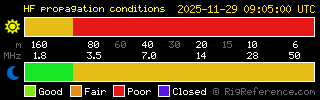
This RigReference Solar Widget gives an indication of the conditions on the various ham bands, for both day and night time.
| Category | Radio Blackouts Use X-Ray |
Solar Radiation Storms Use Proton Flux |
Geomagnetic Storms Use K-Index/K-nT/ Aurora/Solar Wind/Bz |
Band Openings Use Solar Flux (SN) |
Electron Alert Use Electron Flux |
| Extreme | X20 (1 per cycle) Complete HF blackout on entire sunlit side lasting hours |
1000000 (1 per cycle) Complete HF blackout in polar regions |
K=9 (nT=>500) [Aur=10++] (SW=>800) [Bz=-40 -50] (4 per cycle) HF impossible. Aurora to 40°. Noise S30+. |
200-300 (SN=160-250) Reliable communications all bands up through 6m |
>1000 Alert Partial to complete HF blackout in polar regions |
| Severe | X10 (8 per cycle) HF blackout on most of sunlit side for 1 to 2 hours |
100000 (3 per cycle) Partial HF blackout in polar regions |
K=8 (nT=330-500) [Aur=10+] (SW=700-800) [Bz=-30 -40] (100 per cycle) HF sporadic. Aurora to 45°. Noise S20-S30. |
||
| Strong | X1 (175 per cycle) Wide area HF blackout for about an hour on sunlit side |
10000 (10 per cycle) Degraded HF propagation in polar regions |
K=7 (nT=200-330) [Aur=10] (SW=600-700) [Bz=-20 -30] (200 per cycle) HF intermittent. Aurora to 50°. Noise S9-S20. |
150-200 (SN=105-160) Excellent conditions all bands up through 10m w/6m openings |
|
| Moderate | M5 (350 per cycle) Limited HF blackout on sunlit side for tens of minutes |
1000 (25 per cycle) Small effects on HF in polar regions |
K=6 (nT=120-200) [Aur=9] (SW=500-600) [Bz=-10 -20] (600 per cycle) HF fade higher lats. Aurora to 55°. Noise S6-S9. |
120-150 (SN=70-105) Fair to good conditions all bands up through 10m |
<1000 Active Degraded HF propagation in polar regions |
| Minor | M1 (2000 per cycle) Occasional loss of radio contact on sunlit side |
100 (50 per cycle) Minor impacts on HF in polar regions |
K=5 (nT=70-120) [Aur=8] (SW=400-500) [Bz=0 -10] (1700 per cycle) HF fade higher lats. Aurora to 56°. Noise S4-S6. |
90-120 (SN=35-70) Fair conditions all bands up through 15m |
<100 Active Minor impacts on HF in polar regions |
| Active | C1 Moderate Flare Low absorption of HF signals |
10 Active Very minor impacts on HF in polar regions |
K=3-4 (nT=20-70) [Aur=6-7] (SW=200-400) [Bz=0-+50] Unsettled/Active Minor HF fade higher lats. Aurora 60-58°. Noise S2-S3. |
70-90 (SN=10-35) Poor to fair conditions all bands up through 20m |
<10 Normal No impacts on HF |
| Normal | A1-B9 No/Small Flare No or very minor impact to HF signals |
1 Normal No impacts on HF |
K=0-2 (nT=0-20) [Aur=<5] (SW=200-400) [Bz=0-+50] Inactive/Quiet No impacts on HF. Aurora 67-62°. Noise S0-S2. |
64-70 (SN=0-10) Bands above 40m unusable |
<1 Normal No impacts on HF |
VHF Conditions
Aur Lat (Auroral Latitude): Indicates lowest latitude from the current Aurora Activity measurement. Text color coded for low activity, hi-latitude, & mid-latitude.Aurora (Northern Auroral Activity): Band Closed = No/Low Auroral activity. High LAT AUR = Auroral activity >60°N. MID LAT AUR = Auroral activity 60° to 30°N. EsEU (Sporadic E - Europe): Band Closed = No Sporadic E (ES) activity. High MUF (2M only) = Cond support 2M ES 50/70/144MHz ES = Respective band open EsNA (Sporadic E - North America): Band Closed = No Sporadic E (ES) activity. High MUF = Cond support 2M ES 144MHz ES = ES reported @ 2M EME (Earth-Moon-Earth): Current EME degradation. Very Poor (>5.5dB), Poor (4dB), Moderate (2.5dB), Good (1.5dB), Very Good (1dB), Excellent (<1dB). Solar Flare Probability: Provides the probability of a solar flare (in %) for the net 24 hours. MUF (Max Usable Frequency Bar Color): No Sporadic E (ES) activity / ES reported @ 6M / ES reported @ 4M / Cond support 2M ES / ES reported @ 2M MS (Meteor Scatter) Activity Color bar: Provides meteor activity color coded MIN to MAX conditions (see the graph below the bar). ©N0NBH Paul L Herrman 2011 |
|||||
This table and more information may be found at hamqsl.com.
| |||||
The following information was provided by ChatGPT.
Why solar & geomagnetic data matter for radio
Radio propagation, especially on HF bands (e.g. 80 m, 40 m, 20 m, 15 m, 10 m), depends heavily on the state of the Earth’s ionosphere and geomagnetic environment. The Sun is the main driver: its radiation and charged‑particle output affect ionospheric ionization, geomagnetic stability, and signal absorption. By tracking solar flux, solar X-rays, proton/electron flux, and geomagnetic indices, ham operators can predict how “open” or “dead” bands might be, whether long‑distance (DX) contacts are likely, or whether conditions favor local / low‑band / night‑time operation. SolarCdx.com
With that in mind — here’s what the abbreviations you see usually represent:
Key Parameters and What They Mean
Solar Flux Index (SFI)
A measure of solar radio emissions at 2800 MHz (10.7 cm wavelength), expressed in Solar Flux Units (SFU) SolarCdx.com
SFI is a good proxy for how “charged up” the ionosphere is, especially the F‑region. Higher SFI → more ionization → higher Maximum Usable Frequency (MUF). That means HF bands (especially 15 m, 12 m, 10 m) are more likely to be open and support long‑distance DX contacts. sdxa.org
The ionosphere’s electron density determines how well it reflects HF signals back to Earth. Higher SFI values indicate increased solar activity, producing denser ionization and better propagation conditions across most HF bands. solarcdx.com
K-Index (K)
A quasi‑logarithmic index (0–9) measuring short-term (3‑hour) geomagnetic activity — i.e. how “disturbed” Earth’s magnetic field is right now. Why Does the K-Index Matter for Ham Radio?
Low K (0–2) — quiet geomagnetic conditions → HF propagation stable and clear.
As K rises (4, 5, 6, etc.), expect increased noise, signal fading, disturbed propagation, especially on long-distance HF paths.
High K values can also make auroral‑skip (enhanced VHF/UHF propagation via polar‑region ionization), more likely.
Alright, so you’re tuning across the bands, chasing DX, and suddenly things get a little wonky. Signals are fading, getting noisy, or maybe even disappearing altogether. The Kp index is like a heads-up about how much the solar wind is shaking things up around our planet.
Think of the Kp index as a cosmic Richter scale, but instead of measuring earthquakes, it’s measuring the jitters in Earth’s magnetic field caused by that gusty solar wind we were just talking about. This index goes from 0 to 9. A low number, like 0, 1, or 2, is like a calm day – the magnetic field is pretty stable, and generally, your HF signals are going to be happy campers. solarcdx.com
A-Index (A)
A daily average (0–400) derived from the 3‑hourly K‑index values over the past 24 hours or so. Gives a smoothed, longer‑term view of geomagnetic disturbance. SolarCdx.com
A low A (say < 10–15) generally means the geomagnetic field was quiet for the day — good for HF propagation stability.
Higher A (30, 50, etc.) indicates the ionosphere has been “stressed” from persistent geomagnetic activity: expect poorer HF conditions, more absorption, unstable propagation.
The A-index provides a broader view of geomagnetic conditions compared to the 3-hour K-index. Lower A-index values (0-15) generally indicate stable ionospheric conditions favorable for HF propagation, while higher values (30+) suggest increased absorption and signal degradation, particularly affecting long-distance communication paths through the polar regions.
During moderate to severe geomagnetic storms (A ≥ 30), consider operating on lower frequency bands (40m, 80m, 160m) and using NVIS techniques for regional communication. Aurora may enhance VHF/UHF propagation during active periods. solarcdx.com
X‑Ray
Solar X-ray flux (usually the “soft X-ray” flux, 1‑8 Å), often expressed in “class” format (A, B, C, M, X) with a number (e.g. C1.5, M3.2, X1.0). Higher classes = stronger solar flares / radiation bursts. sws.bom.gov.au
X‑rays strongly impact the ionosphere's D‑layer, which absorbs lower‑HF frequencies (80 m, 40 m, 30 m). A big solar flare (M or X class) can cause a sudden HF “blackout” (especially daytime side of Earth). Even moderate flares (C‑class) can cause increased absorption or fading. hamradioweather.com
Ptn Flx (Proton Flux)
A measure of charged‑particle (proton) density/flux in the solar wind / radiation environment arriving at Earth. kj7yyi.net
Elevated proton flux (especially after a coronal mass ejection, CME) can disturb Earth’s magnetosphere and increase geomagnetic activity — which in turn degrades HF propagation. Also relevant to polar‑path propagation and radiation hazards for satellites/spacecraft. QSL.net
Elc Flx: Electron flux (also solar‑wind related particles).
304A: Solar EUV/UV emission at 304 Angstroms (a proxy for solar UV output, which affects F‑layer ionization) bremerfunkfreunde.de
These help gauge longer-term ionospheric ionization potential (UV/EUV → F‑layer) and increased disturbance potential (fluxes → geomagnetic effects) which can affect HF and VHF propagation, as well as sky noise and signal stability. nemarc.org
Also, many solar/space‑weather “banners” combine several of these — e.g. Solar Flux (SFI), Sunspot Number (SN), A & K, X‑Ray, Proton/Electron Flux — to give a more complete picture of propagation conditions. bremerfunkfreunde.de
What to Watch for — Basic Interpretation When You Operate
Best HF conditions (DX potential, higher bands open):
SFI high (e.g. 100+), K low (0–2), A low (0–10), and no recent strong X‑ray flares. That means the ionosphere is well‑ionized but geomagnetically calm.If K or A rise (sign of geomagnetic disturbance):
Expect noise, instability, fading — HF paths might be unreliable, especially long‑distance. Lower HF bands may still work, but long‑haul DX becomes questionable.If you see an X‑ray flare (C, M, or X class) or elevated proton flux:
You may get short-term HF blackout or heavy absorption, especially on lower bands during daylight. That’s a cue to maybe switch to VHF/UHF or wait until the ionosphere recovers.For sustained solar quiet + good SFI + moderate geomagnetic conditions:
Conditions might be good for long-distance DX on mid‑ to high‑HF bands (15 m, 12 m, 10 m), and even occasional openings on VHF via sporadic‑E or other mechanisms (especially if solar/geomagnetic activity triggers favourable conditions).
Summary: Why Each Value Matters
SFI — a strong indicator of how “ionized” the upper ionosphere is, controlling how high you might go in frequency (what bands are open).
K & A — indicators of geomagnetic disturbance; high values mean increased noise / absorption / unstable propagation (bad for HF, sometimes interesting for auroral/VHF).
X‑Ray flux — direct real-time indicator of solar flare activity; flares rapidly affect HF via D‑layer absorption or blackouts.
Ptn Flx / other fluxes — show charged-particle environment and potential for geomagnetic storms, radiation belts, long‑term disturbance; relevant for planning, especially polar‑path or long‑haul HF, or satellite/space‑weather awareness.
HF Propagation Cheat‑Sheet: What to Watch For
Solar Flux Index (SFI / SF or Flux)
< 70 — poor;
70‑99 — fair to marginal;
100‑150 — good;
> 150 — very good / “ideal” conditions rigreference.com
< 70: Expect limited HF propagation; often only low bands (e.g. 40 m, 80 m) are usable. rigreference.com
Expect challenging propagation with weak signals and limited DX opportunities
Higher HF bands (20m, 17m, 15m, 12m, 10m) may be completely closed during daylight
Rely primarily on 80m and 40m for reliable communications
NVIS propagation on 80m/40m becomes your primary tool for regional contacts
70‑99: Mid‑bands (20 m, maybe 17 m) may open; 15 m+ possibly weak or spotty.
Moderate propagation with intermittent openings on mid-bands
20m typically reliable during daylight hours with moderate DX potential
17m and 15m may show brief openings, particularly around solar noon
40m remains solid for regional and some DX work
Digital modes become more effective on marginal bands
100‑150: Good for 20 m, 17 m, 15 m; you may get solid DX on mid‑HF.
150-300: Excellent for higher HF (15 m, 12 m, 10 m), possibly extended openings and long‑distance contacts. IW5EDI Simone - Ham-Radio
Excellent propagation across all HF bands
20m, 17m, 15m, 12m open consistently with strong DX signals
10m may open for sporadic E and F2 propagation during solar maximum periods
Lower noise floors and stronger signal strengths
Ideal conditions for contest operations, DXpeditions, and weak-signal work
Enhanced propagation paths support both short and long-distance communications
K‑Index (3‑hour geomagnetic index)
0–2 — very quiet;
3 — quiet/unsettled;
4–5 — active to storm‑level / degraded;
6+ — major geomagnetic disturbance / poor hamradioweather.com
• 0–2: Excellent propagation stability — bands clear, less noise/fading.
• 3: Still generally good, maybe some slight instability; good mid‑band performance (e.g. 20 m–17 m), but lower bands begin to suffer.
• 4–5: Expect increased noise, fading, unstable long‑path propagation; higher HF may be patchy, lower bands (80 m, 40 m) more usable though with noise. hamjournal.org
• 6+: Geomagnetic storm conditions — poor HF propagation, possible blackouts, high noise, unpredictable MUF. hamradioweather.com
A‑Index (daily average geomagnetic index)
0–7 — very quiet;
8–15 — unsettled;
16–29 — active / minor disturbance;
30–50 — minor storm;
50–99 — major storm;
100+ — severe geomagnetic storm
• 0–7: Excellent HF conditions; stable ionosphere — good for DX, weak‑signal work, long‑distance links.
• 8–15: Slightly unsettled; possible minor noise or fading, but many HF bands still usable. Slight degradation on higher bands. Mid/low bands (40m, 80m, 160m) still excellent. Good conditions for most HF activities.
• 16–29: Noticeable degradation on higher HF (15 m, 12 m, 10 m); mid to low HF (20 m, 40 m, 80 m) still usable but with more noise. Focus on 40m and below.
• 30–50: Conditions becoming poor for higher bands; significant absorption or blockage; low‑band HF might still work but with noise and instability. Poor conditions overall. HF blackouts possible on higher bands. Enhanced auroral activity may benefit VHF/UHF operators
• 50+: Very poor HF propagation overall; long‑distance contacts unlikely; even regional communications may struggle. Most bands unstable with severe signal degradation. Both NVIS and DX propagation significantly impaired. Consider QRT.
Combinations (SFI + A/K)
— High SFI and Low K/A is ideal
— High SFI but High K/A → Mixed or poor
— Low SFI but Low K/A → Limited but stable lower‑band work
• High SFI + Low K/A → Best case: high HF (15–10 m) open, stable DX contacts likely.
• High SFI but High K/A → Ionosphere ionized, but geomagnetic disturbance causes absorption/fading; higher bands may struggle, lower bands may be noisy.
• Low SFI + Low K/A → Good for lower HF (40 m, 80 m, maybe 160 m) — stable local/regional contacts, less long‑haul DX.
How You Can Use This Cheat Sheet
Before you key up: Check SFI, K‑Index, A‑Index. If SFI is high (100+ or better) and K & A are low — that’s your cue to try higher‑frequency bands (15 m, 12 m, 10 m) for DX.
If K or A is elevated (say A > 30 or K ≥ 4): Don’t rely on higher‑HF — switch to mid/low‑HF (20 m, 40 m, 80 m) or consider local/regional contacts, especially near geomagnetic storm peaks.
When both SFI is low and geomagnetic indices are low: Use lower bands (40 m, 80 m, 160 m) — ideal for local/regional QSOs; long‑haul may be unlikely.
For contesting, DX chasing, morning/evening greyline work: Watch for times when conditions swing — sometimes storms decay and MUF rises, or quiet periods follow storms giving unexpected openings.
Additional Space‑Weather Parameters — What They Mean & Impact on Radio
X‑Ray Flux / Solar Flares
A burst of electromagnetic radiation (X‑rays + UV) from a solar flare — reaches Earth in ~8 minutes. NOAA Space Weather Prediction Center
• Causes a rapid increase in ionization of the D‑layer of the ionosphere on the sunlit side of Earth. NOAA Space Weather Prediction Center
• This increased ionization drastically increases absorption of HF radio waves, especially the lower frequencies (e.g. 80 m, 40 m, 30 m). NOAA Space Weather Prediction Center
• Result: Temporary “HF radio blackouts” or strong fadeouts — sometimes entire bands go dead. NOAA Space Weather Prediction Center
• The intensity of the flare (class, e.g. C, M, X) determines severity — minor flares = slight absorption, major (M/X) = possible blackout. hamwaves.com
Solar Proton Flux / Proton Events (Ptn Flx)
High‑energy protons (and sometimes other particles) ejected from the Sun (often during a flare or a related coronal mass ejection / CME), traveling toward Earth; measured by satellites. hamradioweather.com
• When protons enter Earth’s atmosphere — especially near the magnetic poles — they enhance ionization in the D‑layer again, but over a broader area (particularly high latitudes). This is often called a Polar Cap Absorption event (PCA). NOAA Space Weather Prediction Center
• PCA greatly increases HF absorption, making HF communications (especially via polar or high‑latitude paths) very poor or impossible. hamradioweather.com
• Even mid‑latitude or non‑polar paths may suffer: fading, noise, reduced reliability — especially on lower HF bands (80 m, 40 m, etc.). hamradioweather.com
• Proton‑flux effects tend to last significantly longer than X‑ray flare effects (hours to days), depending on the duration/strength of the event. hamradioweather.com
Charged‑Particle / Electron Flux & Other Particle-Related Indices
Energetic particles (electrons, protons, sometimes heavier ions) from solar storms / CMEs / general solar wind; these can disturb Earth’s magnetosphere and upper atmosphere. sws.bom.gov.au
• Can lead to geomagnetic storms, which distort or disturb the ionosphere (especially F‑layer), changing propagation conditions — often lowering the maximum usable frequency (MUF) and causing unstable propagation or higher noise. hamsci.org
• May contribute to auroral effects / increased noise for high-latitude VHF/UHF (if aurora‑linked electrons precipitate) — though HF impacts tend to dominate for global comms. NOAA Space Weather Prediction Center
Combined Events: Solar Flare + CME (leading to Proton/Electron Storm + Geomagnetic Storm)
A flare gives initial X‑ray / UV impact; a CME (or associated particle storm) arriving hours/days later adds charged particle bombardment and magnetic disturbance. cdn.rohde-schwarz.com
• The flare can cause an immediate HF blackout. If followed by a proton or geomagnetic event, HF conditions may remain degraded for many hours or even days — affecting all bands, making long-distance or stable contacts unlikely. cdn.rohde-schwarz.com
• Especially polar or near‑polar paths (e.g. to high latitudes) may remain unusable.
• Mid‑latitude users (like you in Georgia, USA) may still get some contacts — but expect unstable conditions: noise, signal fading, shifting MUF, unpredictable propagation. Amateur Radio News from Jon Stow, G4MCU
When to Be Especially Careful — Warning Signs from Space‑Weather Data
A big solar‑flare just occurred (X‑ray flux jumped, “X‑class” or “M‑class” flare) — expect HF blackout (especially on lower bands) on the sunlit side of Earth for possibly minutes to an hour.
Proton flux elevated (especially > threshold for Proton Storm) — if you see proton flux rising, and maybe CME warnings — good chance of Polar Cap Absorption: poor or no HF comms via polar/high‑latitude paths, elevated noise, signal fade.
Geomagnetic disturbance + particle flux — even if solar flux (sunspot activity) is high, the combined disturbance may degrade or wipe out stable HF propagation; higher bands (which normally benefit from high solar activity) may be unreliable or noisy — mid / lower bands might be your only usable option.
During/after an event — Even if X‑ray flux subsides, proton/electron storms or disturbed magnetic fields may linger hours or days. Propagation may be very unpredictable for a while.
What This Means for You — Practical Advice
Check not just solar flux (SFI) and sunspots — but also X‑ray flux & proton/electron flux reports before deciding which bands to use this session.
If a flare is happening (X‑ray spike): switch away from lower HF (80 m, 40 m, 30 m). If you want to try something, mid‑HF or VHF/UHF may fare better — or just wait it out until the D‑layer ionization subsides.
If prolonged solar‑wind / proton activity or geomagnetic alerts: expect unstable propagation — DV/digital modes (e.g. FT8) may still succeed, but typical phone/CW DX might be rough; polar‑route communications (e.g. to Europe/Northern latitudes) may be poor.
During quiet geomagnetic and particle‑flux times (even if solar activity is high): that’s often the best window for DX — especially on higher HF bands (15 m, 12 m, 10 m).
Have a fallback strategy: If HF is patchy or unavailable, consider VHF/UHF, local nets, or non‑ionospheric modes — or simply wait a bit and monitor space‑weather updates.